
In March, WASANet launched its 2026 webinar series to drive dialogue on water security and innovation in Southern Africa within the Water Security in Africa (WASA) network and beyond. The WASA Webinar Series unites academia, industry, and policy through a dynamic two-part format including a technical or academic presentation from a WASA project partner, followed by a public or private sector perspective on the relevance and application of the technology within Sub-Saharan Africa’s water sector.
Freshwater in Hostile Terrain – Aquifers, Sensors & Basin Solutions
The webinar series kicked off on 25 March with a first session featuring Prof. Kawawa Banda (University of Zambia, Zambia) and Dr. Anna Matros-Goreses (Namibia University of Science and Technology, NUST, Namibia). The webinar explored the challenges of water security, groundwater salinity, and the Water-Energy-Food (WEF) Nexus in Southern Africa, drawing on case studies from the Machile–Zambezi Basin and Cuvelai Basin.
The presentations highlighted the growing impacts of climate change on groundwater resources, with projections indicating significant reductions in groundwater recharge and increasing aridity across the region. Prof. Banda emphasised that groundwater salinity is an emerging threat to freshwater security, while presenting innovative research investigating the presence of deep freshwater aquifers beneath saline groundwater systems.
Dr. Matros-Goreses showcased the Smart Water Energy Food Nexus Innovation Model (SWIM) project, demonstrating how smart sensors installed in Namibia’s Cuvelai Basin provide real-time monitoring of water quality and leak detection. Both speakers stressed that technology should be developed in partnership with stakeholders to address real community needs, rather than focusing solely on technological innovation itself.
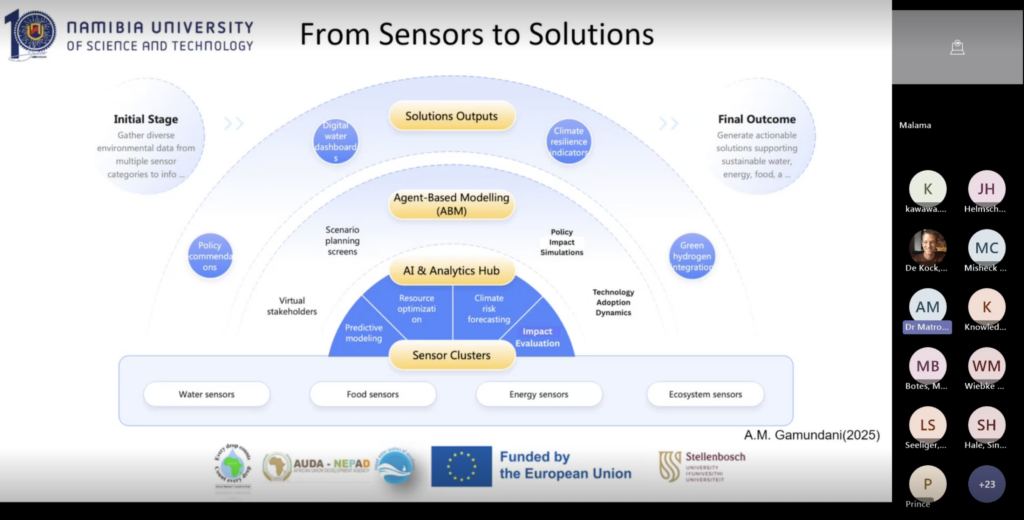
The webinar generated discussion around the feasibility of desalination, opportunities for integrating green hydrogen with water management, the potential contribution of mining companies through Corporate Social Responsibility, and the application of semi-airborne geophysics for identifying freshwater resources beneath saline layers.
Looking ahead, the speakers highlighted several priorities, including mapping and protecting groundwater recharge zones, promoting climate adaptation strategies such as rainwater harvesting and salinity-tolerant agriculture, and deploying innovative drone-based semi-airborne geophysics to improve groundwater exploration. Future work will also expand the WEF Nexus dashboard by integrating food and energy data, while scaling these technologies to additional river basins. The webinar reinforced the urgent need for innovative, data-driven approaches to strengthen water security in Southern Africa, a region where climate change is accelerating aridity and placing increasing pressure on water resources and agricultural livelihoods.
As Dr. Anna Matros-Goreses concluded:“The true value of the innovation is not about the tool. It’s about the ability to solve the problems of our stakeholders.” Prof. Kawawa Banda echoed this sentiment by emphasising:“Through the WASA project, we feel that innovative technologies are critical to unpack the limitations that have been created by our traditional methods.”
36 participants
Advancements on Water Remediation and Treatment Technologies
The second webinar in the WASA Webinar Series, hosted by WaMiSAR on 6 May, explored advancements on water remediation and treatment technologies. The session featured presentations by Prof. Andrea Schäfer (Institute for Advanced Membrane Technology, Karlsruhe Institute of Technology, Germany) on “Renewable Energy Powered Membrane Technology for Water Treatment” and Dr. Stephan Hüttmann (Sensatec GmbH, Germany) on “How Close Cooperation Between Scientific Research and Industry Leads to Better Solutions to Tackle Environmental Issues.”
Opening her presentation with the inspiring vision, “I have a dream: safe drinking water for all children,” Prof. Andrea Schäfer highlighted how scientific innovation can improve water security worldwide. Together with Dr. Stephan Hüttmann, the speakers demonstrated how close collaboration between academia and industry is driving practical solutions for water contamination, groundwater remediation, and environmental protection. Prof. Schäfer presented pioneering work on renewable-energy-powered membrane systems that directly couple solar and wind energy with nanofiltration and reverse osmosis technologies to remove dissolved contaminants, including fluoride, arsenic, uranium, nitrate, pesticides, and natural organic matter from brackish water. The research demonstrated that decentralised, battery-free membrane systems provide a resilient, cost-effective solution for rural and remote communities where electricity grids and piped water infrastructure are limited or absent.
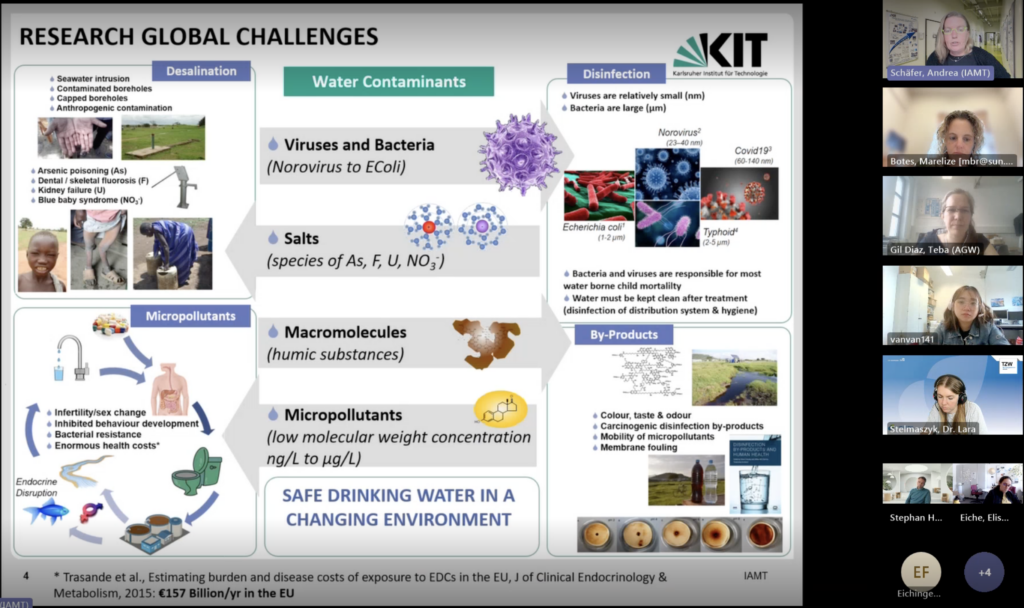
Dr. Hüttmann showcased innovative approaches for in situ soil and groundwater remediation, emphasising the importance of combining geohydrological, geochemical, and microbiological expertise to design effective site-specific remediation strategies. He also discussed emerging technologies for tackling persistent contaminants such as per- and polyfluoroalkyl substances (PFAS), highlighting the growing need for integrated treatment approaches as these pollutants become an increasing global concern.
The presentations initiated discussions on the operational limits of renewable-energy-powered membrane systems for highly saline waters, sustainable management of membrane concentrate streams, the ongoing technological challenge of removing short-chain PFAS compounds such as trifluoroacetic acid (TFA), and the time required to translate research into full-scale remediation projects.
Several key recommendations emerged from the webinar. The speakers pointed out that developing countries should have access to the same high-quality, environmentally sustainable technologies available elsewhere rather than lower-cost alternatives with reduced performance. For decentralised water treatment, low-recovery membrane systems were recommended to maximise drinking water production while minimising waste. In industrial remediation, precision technologies such as sensor-guided drilling and targeted reagent injection offer significant improvements in remediation efficiency. The importance of responsible business models was also highlighted, with technology providers encouraged to maintain long-term operational support until sufficient local technical capacity has been established.
Looking ahead, several challenges remain. Persistent contaminants such as TFA continue to lack effective treatment technologies, while membrane scaling, infrastructure security, and long-term investment remain barriers to widespread implementation. Future research will focus on deploying additional field-scale membrane systems to evaluate long-term performance, improve operational reliability, and support wider implementation of renewable-energy-powered treatment technologies.
The webinar demonstrated how innovative water treatment and remediation technologies can significantly strengthen water security in regions facing increasing pressure from climate change, industrial development, and emerging contaminants. By integrating renewable energy with advanced treatment systems and fostering close collaboration between research institutions, and industry, these technologies offer practical pathways toward achieving safe, sustainable water supplies across Southern Africa and beyond.
19 participants
Open-Source Software for Processing TEM and ERT Data Helps Aquifer Characterisation
The third webinar, hosted by SeeKaquA on 4 June, focused on how open-source software for processing TEM and ERT data helps aquifer characterisation. The session featured academic insights from Prof. Dr. Thomas Günther (TU Bergakademie Freiberg, Germany) and practical perspectives from Dr. Stephan Costabel (Federal Institute for Geosciences and Natural Resources, BGR, Germany).
Both speakers demonstrated how open-source software is transforming groundwater exploration by making advanced geophysical data processing, interpretation and visualisation more accessible to researchers, students, and water practitioners. The webinar introduced an integrated open-source Python ecosystem for processing, inversion and three-dimensional visualisation of Transient Electromagnetic (TEM) and Electrical Resistivity Tomography (ERT) data. Built around PyGimli as the core modelling platform, together with EmpireMod, QGIS and the Temploader plugin, the workflow enables researchers to efficiently process geophysical datasets, map survey profiles and generate 3D visualisations that improve aquifer characterisation.
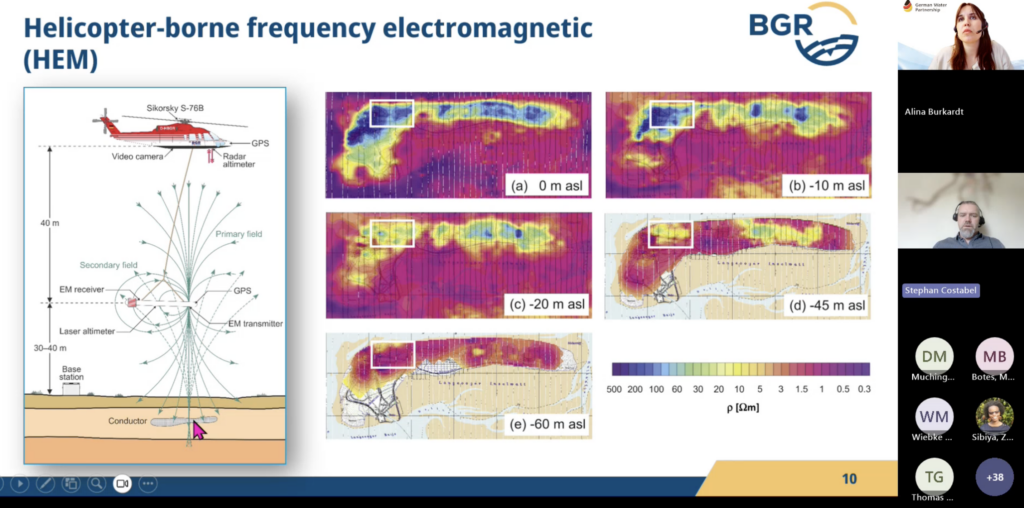
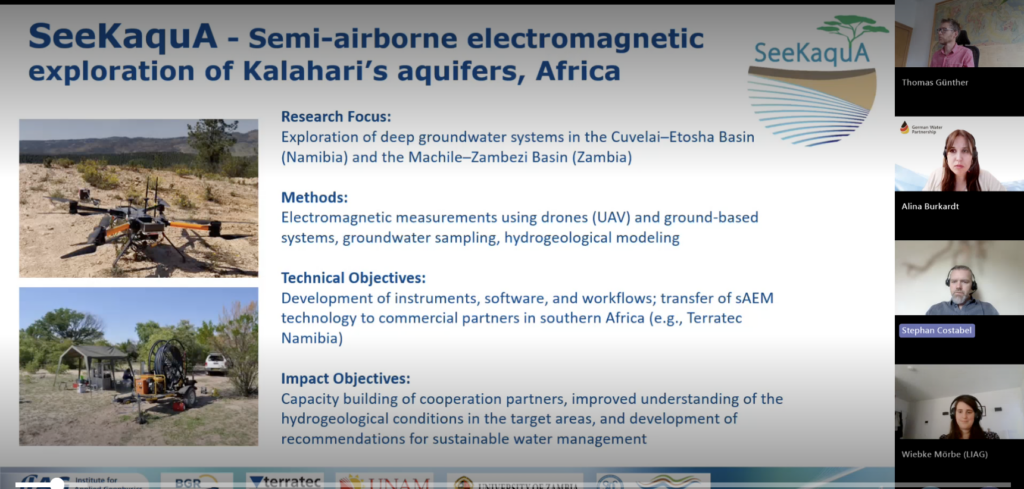
A key message throughout the presentations was that no single geophysical method can adequately characterise complex groundwater systems. While TEM and ERT provide valuable information on subsurface electrical resistivity, both saline groundwater and clay-rich sediments produce similar low-resistivity signals. The speakers demonstrated how combining complementary techniques, such as Magnetic Resonance Sounding (MRS), seismic surveys and borehole information, significantly improves the accuracy of groundwater models and reduces uncertainty in interpreting subsurface conditions.
The webinar generated valuable discussion on the accessibility and reliability of open-source software compared with commercial alternatives. Participants were encouraged that only basic Python knowledge is required to begin using these tools, making them highly suitable for university teaching and research. The speakers also highlighted how open-source geophysical software is following a similar path to QGIS by building an active global user community that continuously improves the available tools.
Several important recommendations emerged from the webinar. Researchers were encouraged to adopt multi-method geophysical investigations and integrate diverse datasets, including geophysics, borehole information, and geological knowledge, to develop more reliable groundwater models. Equally important is investing in open educational resources and training programmes to build the technical capacity required for widespread adoption of open-source technologies.
Looking ahead, significant scientific challenges remain. Groundwater systems within the SeeKaquA project study areas in Namibia and Zambia occur at considerable depths, exceeding the effective investigation range of some existing geophysical methods. Future work will therefore focus on combining complementary electromagnetic techniques and producing high-resolution three-dimensional resistivity models for the Etosha and Machile basins to improve estimates of deep freshwater resources and support sustainable groundwater development.
The webinar demonstrated how open-source technologies are helping to strengthen water security across Southern Africa by improving understanding of aquifer systems, preventing groundwater contamination caused by over-abstraction, and supporting predictive groundwater management. As climate variability and water demand continue to increase, these collaborative, accessible technologies will play an increasingly important role in identifying and protecting strategic groundwater resources for drought resilience and sustainable development.
Reflecting on the importance of integrated geophysical investigations, Dr. Stephan Costabel concluded:“We saw that complex hydrogeological systems cannot be analysed by one single geophysical method. So at least we have to apply several electromagnetic methods with different resolution properties.”
48 participants