
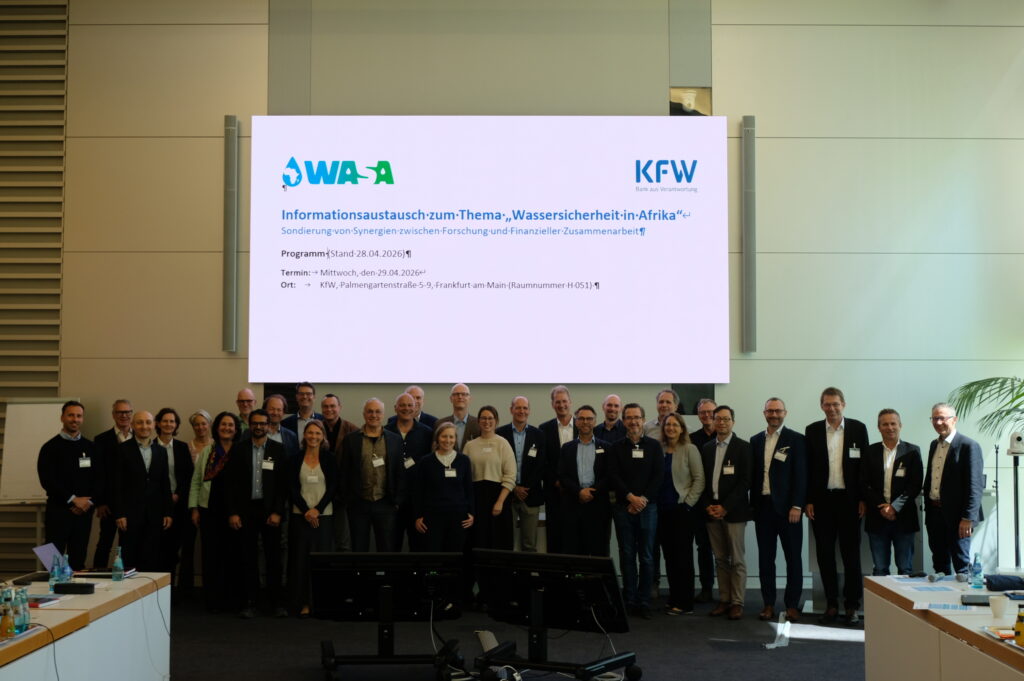
At the end of April, project coordinators and private sector partners from the Water Security in Africa (WASA) research programme met with KfW experts, and representatives of the German Federal Ministry of Research, Technology and Space (BMFTR) and the German Federal Ministry for Economic Development and Cooperation (BMZ) at KfW’s head office in Frankfurt am Main to discuss opportunities for financing and upscaling their innovative solutions.
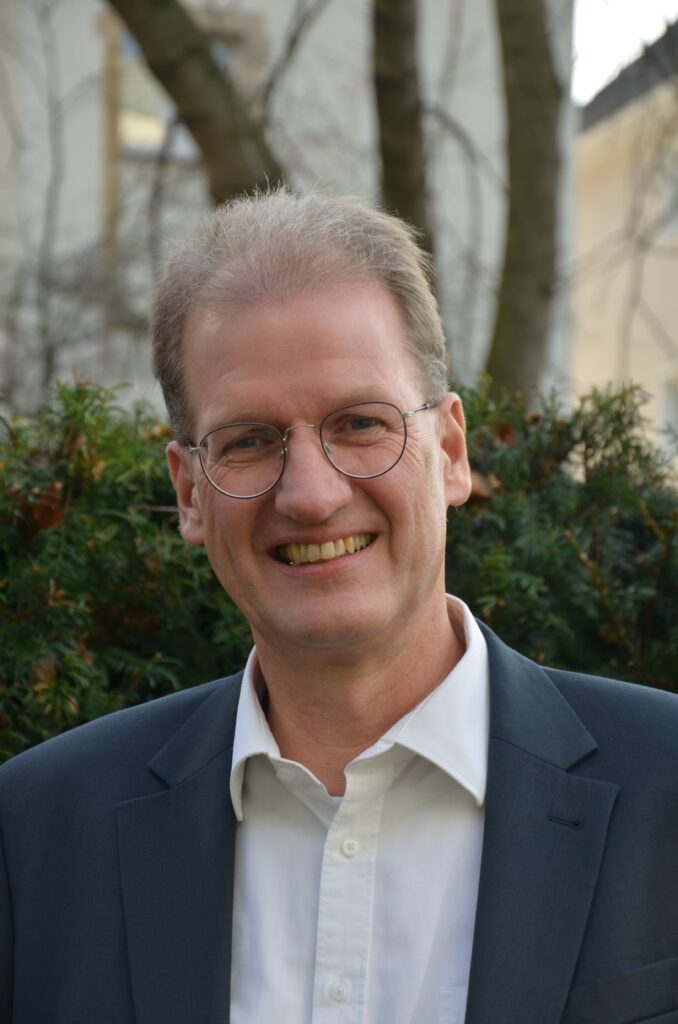
In the interview, Dr. Bernd Wiebusch, Senior Technical Expert and Technical Coordinator for Water and Waste at KfW, provides insights into KfW’s financing instruments and the potential for financing WASA projects within the German Development Cooperation.
What was your impression of the seven collaborative research projects and the presented innovations?
Three of the seven presented R&D projects have been identified to have the technical potential for further development under the framework of the German Development Cooperation (GDC). This could be the MAMDIWAS project, the WaReNam project and the NEU-Water project (together with the Water-Hub project of the Technical University of Munich (Prof. Drewes, financed by the Federal State of Bavaria)).
However, any future subsidised funding by the German Development Cooperation depends on the willingness of the German Ministry for Economic Cooperation and Development (BMZ) to adjust the sectoral focus in South Africa slightly as the focus is currently on the energy sector. Water projects therefore can currently only be financed by KfW if they have a strong energy focus as well (e.g. anaerobic sludge stabilisation combined with power production).
Furthermore, the Federal Institute for Geosciences and Natural Resources (BGR) developed a semi-airborne electromagnetic exploration system for aquifers and applied it in the Kalahari in Namibia (SeeKaquA project). As implementation agency of the BMZ the BGR does have full access to financing of the German Development Cooperation. GDC projects could use this new know-how to explore groundwater reservoirs within usual feasibility studies.
Finally, the Export Initiative Environmental Protection (EXI) project EcReuse of the FIW Aachen in Buffalo City might have a potential for a subsidised development loan as it would introduce innovative technology for South Africa.
As some of the potential Project Executing Agencies are private companies, they could request support from the KfW subsidiary DEG (Deutsche Investitions- und Entwicklungsgesellschaft). KfW Development Bank is primarily working with the public sector.
How has KfW’s portfolio in the water and sanitation sector evolved in recent years, and what trends are shaping its investment priorities?
In the German Development Cooperation, the water sector faced declining funding during the last years, although it is still one of the largest sectors of the GDC in terms of financial commitments. Water projects often last very long, and besides providing access to clean and safe water and sanitation to the people according to SDG 6, they have a high relevance for climate resilience, especially adaptation and mitigation. Additionally, the refugee context and the strengthening of the local economies has become very important in some countries.
As the German and European industry are very competent in delivering goods and services for water supply and sanitation, it can be assumed that the water sector will keep its fundamental role in the German Development Cooperation.
Which thematic areas of the WASA programme are of particular interest to KfW when considering new investments in the African water sector? (sustainable water resources management, water infrastructure and water technology, hydrological forecasts and management of hydrological extremes)
For Africa as a whole continent the question cannot be answered. Water management is always a very local business, which depends on the local water cycle and conditions (precipitation, runoff, evaporation, water storage, water quality, groundwater availability).
How do topics such as nature-based solutions, urban water resilience, mining, climate adaptation, or hydrological forecasting fit into KfW’s current priorities?
The topics nature-based solutions, urban water resilience, and climate adaptation fully comply with the strategic goals of the BMZ on behalf of which KfW is acting. Some solutions can and should be nature-based. Since the mining industry is usually part of the private sector, its support would principally be the business area of the DEG. Hydrological forecasting might be part of a usual feasibility study to prepare a water supply project.
As mentioned above, it is not possible to define technical topics as priority of the KfW as we are acting on behalf of the BMZ. The main job of KfW is to implement the political strategy of our German Ministry and to develop and promote the relevant financing instruments. For example, up to now the political strategy of the BMZ for South Africa is to reduce the carbon footprint which is very high. Therefore, energy projects are currently the focus of any financing projects.
Are there any key requirements for innovations, private sector, and African countries that make them more eligible for KfW credit financing?
At the end, our financing with products fully depends on the risk analysis of KfW and of the partner institution. If infrastructure which is currently not a state-of-the-art-technology (e.g. technology readiness level 5 to 7) is assessed positively the stakeholders might be prepared to cover higher risks. In case of a grant the main part of the risk lies with the Development Cooperation and in case of a loan it mainly stays with the Project Executing Agency in our partner countries and their payback structure. So, each project needs an individual decision of both sides.
What financing instruments or funding pathways does KfW offer for innovations emerging from research programmes such as WASA?
KfW does not have a special product to finance innovations from technical research programmes. Implementing innovative technology strongly depends on the willingness of the local project partners in the partner countries to implement innovative solutions. The customer decides to take higher risks related with innovative solutions and the Bank needs to decide for it as well. Progressing the usual financial products could be applied depending on the availability of grants from the BMZ or other Ministries.
The financing instruments themselves are depending on the financial status of a partner country. KfW does have a rating which indicates the possibly of loans or even not. As Bank KfW is interested in giving loans. However, KfW can use special products like Development Loans, Interest-reduced Loans or Promotional Loans which are subsidized by grants from BMZ. For all these products KfW does need the approval of the BMZ. As International Bank with a Triple-A-Rating KfW can offer market-oriented loans with often good conditions.
In light of the upcoming 2026 UN Water Conference, what potential do you see for the collaborative research design of the WASA projects, and their scalability, to make a meaningful contribution to achieving SDG 6?
The UN General Assembly has identified six key priority themes for the 2026 conference:
- Water for people: safe access to drinking water and sanitation.
- Water for prosperity: water as a basis for business, industry and agriculture.
- Water for the planet: protecting ecosystems, biodiversity and water bodies.
- Water for cooperation: transboundary water use and peaceful cooperation.
- Water in multilateral processes: strengthening global water policy.
- Investment in water: financing, technology, innovation and capacity building.
The last point does mention innovation. Therefore, it can be assumed that technological innovation in the water sector is highly welcomed to help achieving SDG 6. But it will depend on each individual project how far innovative methods can be applied.