
The WaMiSAR project team presented new research findings at two international scientific conferences, highlighting innovative approaches to mine rehabilitation in Namibia’s arid and semi-arid landscapes.
New insights presented at the EGU General Assembly 2026
At the EGU General Assembly 2026 (3–8 May, Vienna, Austria), the team presented the poster “Integrated Assessment of Vadose Zone Physical and Hydraulic Properties in Semiarid and Arid Mining Landscapes in Namibia.”
The study showed that, in semi-arid mine residue deposits, successful vegetation establishment depends less on maximizing water-holding capacity than on creating topsoil conditions that can rapidly capture rainfall after long dry periods while minimizing runoff losses. These findings are particularly relevant for improving mine rehabilitation strategies in water-limited environments, where making the most of infrequent rainfall is critical for successful revegetation.
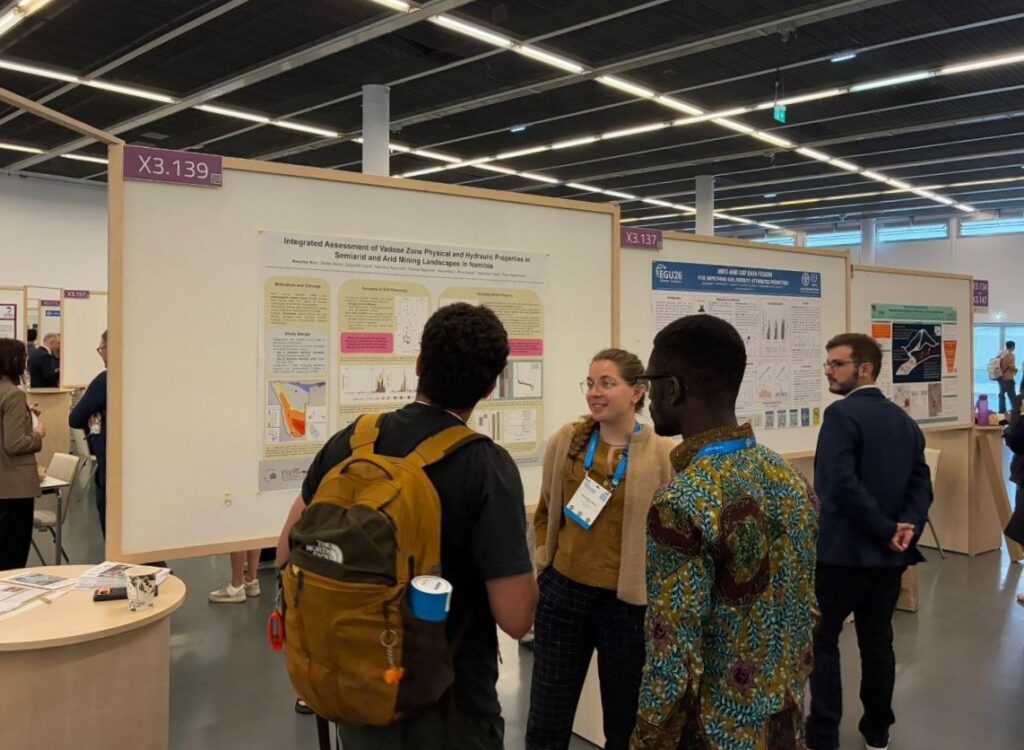
The poster attracted considerable interest at the conference and received very positive feedback from attendees. Discussions highlighted the potential additional role of the sand layer as an evaporation barrier, helping to retain moisture in the vadose zone and further supporting vegetation establishment. This exchange of ideas provided valuable input for the ongoing research.
Oral presentation at the World Congress on Soil Sciences
WaMiSAR was also represented at the 23rd World Congress on Soil Sciences (7–12 June, Nanjing, China) with the oral presentation “The Dependency of Spontaneous Vegetation Growth on Soil and Tailing Material on Mine Residue Deposits at Different Climates in Namibia.”
The presentation highlighted how spontaneous vegetation on mine residue deposits is primarily influenced by the physical properties of the surface soil rather than by the presence of metal contaminants. Across two contrasting climatic regions in Namibia, the study showed that vegetation establishes predominantly on sandy surface layers, while silt, salt crusts and coarse cover materials strongly limit plant growth. The ongoing research aims to translate these findings into practical guidance on suitable soil conditions, plant selection and the sustainable use of mine water for irrigation during vegetation establishment.
These results are particularly relevant for the development of climate-adapted and cost-effective mine rehabilitation strategies in arid and semi-arid regions. By identifying the conditions that naturally promote vegetation growth, the project will support evidence-based decision-making for mine closure and land restoration, with potential applications beyond the study sites in Namibia.
The presentation attracted considerable interest from conference participants, particularly regarding the potential to combine natural revegetation processes with sustainable mine water management.
Strengthening collaboration across WASA projects
On 2 July 2026, partners from the WaMiSAR, MAMDIWAS and WaReNam projects met in Frankfurt for a joint exchange workshop hosted by the Institut für sozial-ökologische Forschung (ISOE), a WaReNam partner.
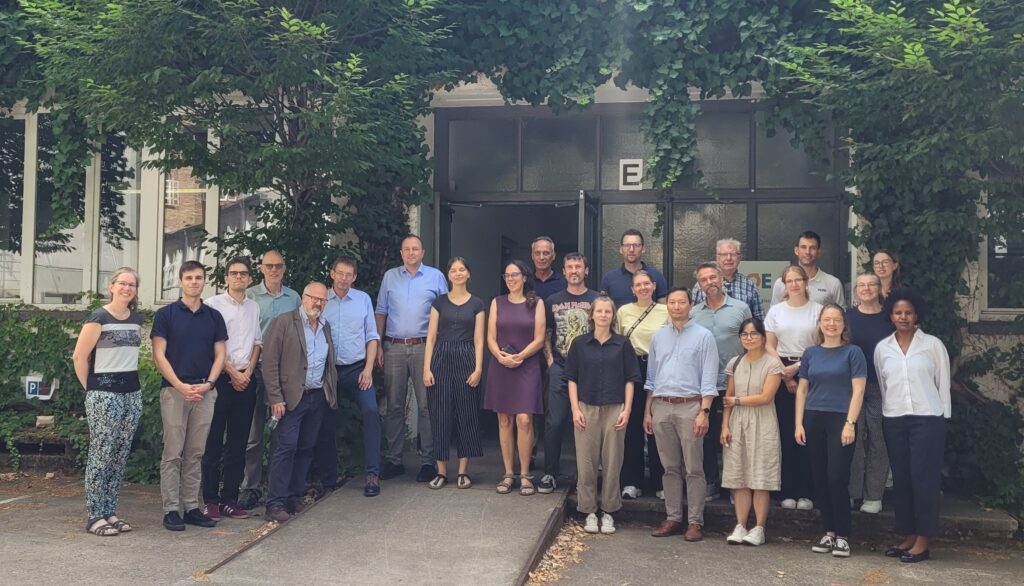
Bringing together three interconnected WASA projects, the meeting provided an opportunity to share experiences, discuss common challenges, and explore strategies for successful project implementation. Through open dialogue and knowledge exchange, participants aimed to strengthen collaboration and identify synergies that can enhance the impact of their work.
The exchange was highly successful and has already led to plans for a second joint meeting, which will be hosted by the MAMDIWAS project next spring.
Authors:
Prof. Dr. Stefan Norra, Teba Gil Diaz
For more information and details, please visit the WaMiSAR project website.
More information on all seven projects can be found here and in the programme publication.
