
Pilot Plant Successfully Constructed and Commissioned
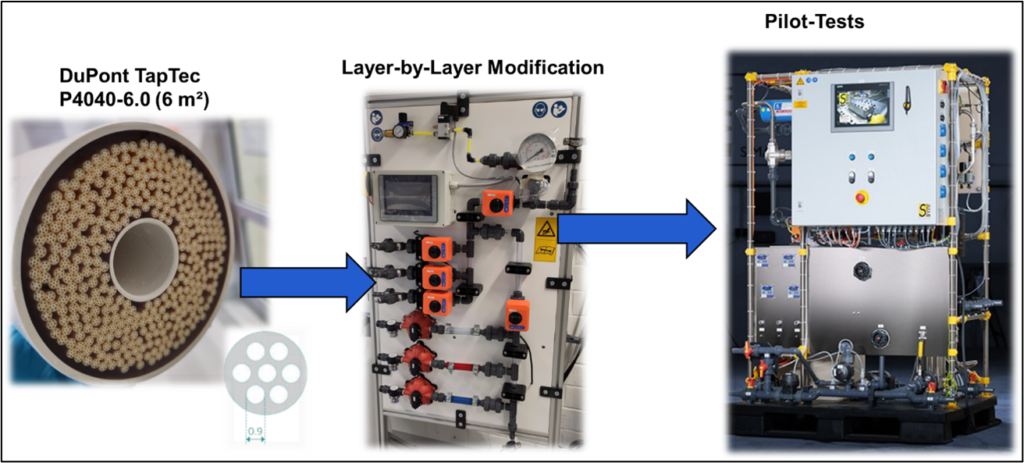
The MAMDIWAS project has reached a major milestone with the successful construction and commissioning of its pilot systems. The core idea is the transformation of a polymeric ultrafiltration (UF) membrane into a capillary nanofiltration (cNF) membrane using the innovative Layer-by-Layer (LbL) technique, and running this membranes in so called Slurry Precipitation and closed-circuit Nanofiltration (SPANF) enabling advanced treatment and future reuse of mine-influenced water (MIW).
The first pilot unit, built by SIMA-tec GmbH, has been transported to Duisburg and is now being tested under controlled laboratory conditions at the University of Duisburg-Essen. In 2026, it will operate at a closed mining site of RAG Aktiengesellschaft in Bochum, before being deployed at an active gold mine of Sibanye-Stillwater near Johannesburg.
Two supporting systems are also involved; a membrane coating unit by Dähne Labortechnik GmbH and Surflay Nanotec GmbH for producing LbL-NF membranes, and a pretreatment unit by UNISA and ROC Water Technologies, focusing on removing pollutants and recovering valuable resources.
Together, these systems aim to demonstrate how MIW can be transformed into a reusable water source, contributing to water security, circular resource management and sustainable post-mining development in Germany and South Africa.
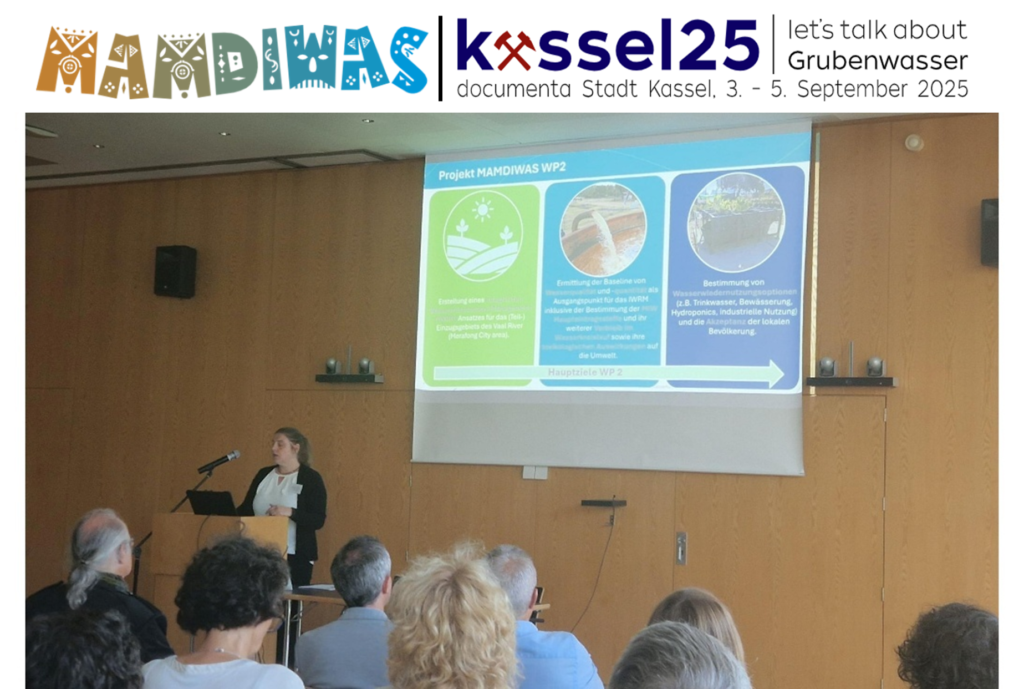
Presentation of MAMDIWAS at the Mine Water Conference Kassel 2025
IWW successfully presented MAMDIWAS at this year’s Grubenwassertagung in Kassel (Mine Water Conference) on September 4th. The conference brought together representatives from science, research, industry, and regulatory authorities, attracting a highly specialized audience from across Germany. It provided an excellent platform to showcase our innovative approach and engage with experts on sustainable mine water management.
Katharina Gimbel, from IWW institute, presented the current activities of the MAMDIWAS project under the title “Between Risk and Resource, Mine-influenced water as Challenge and Opportunity”. Her presentation highlighted initial findings of the first two sampling campaigns in South Africa and focus on assessing water quality within the catchment area, identifying key pollutants originating from mine-influenced water and evaluating their toxicological effects, as well as exploring reuse options and analyzing public acceptance. The goal is to derive informed strategies for water protection and the sustainable management of water resources.
The presentation generated high interest in the project, leading to numerous positive responses and engaging technical discussions with experts from various fields. We received valuable feedback and enjoyed a productive exchange of ideas with colleagues, which will help shape the next steps of our research. The strong interest and constructive dialogue confirmed the relevance of our work developing innovative solutions for mine water challenges.
MAMDIWAS Delivers First Governance Report (D3.1)
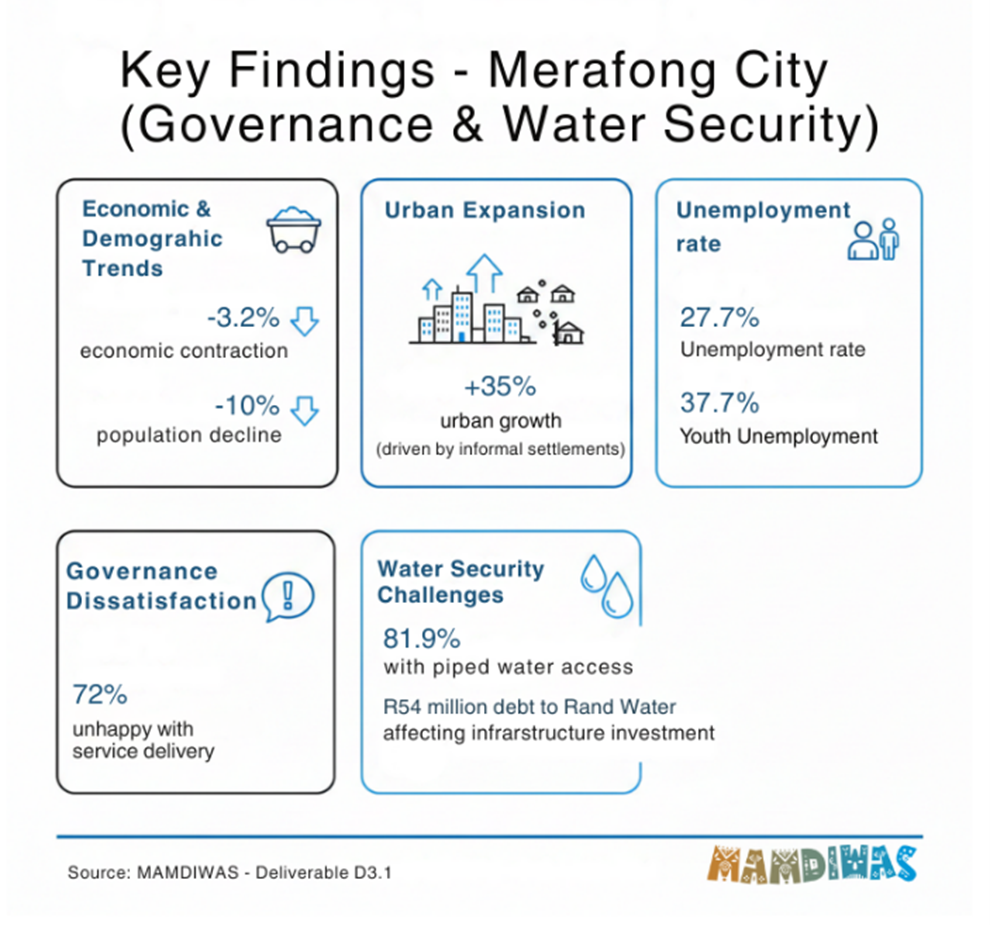
The first governance deliverable of MAMDIWAS provides an overview of the policies, regulations and institutional dynamics shaping the management of mining-influenced water and post-mining transition in Merafong City, South Africa. The assessment analysed national legislation, municipal planning frameworks and the roles of government, mining companies and civil society.
The findings reveal major structural challenges. Although Merafong’s mining economy declined by 3.2% and the population decreased by 10%, the urban footprint expanded by 35%, largely due to informal settlements. Unemployment remains high at 27.7%, with youth unemployment at 37.7%, and 72% of residents report dissatisfaction with service delivery. Water security issues persist: 81.9% of households have piped water, yet non-revenue water reaches 36.6%, and municipal debt of roughly R54 million limits infrastructure investment.
On the regulatory side, South Africa has a strong legal framework for mine closure and environmental oversight, but implementation is inconsistent. Coordination gaps between key departments, unresolved long-term liabilities and limited enforcement continue to hinder effective transition. Communities also experience weak consultation, limited cooperation between municipalities and mining houses, and increasing illegal mining near abandoned shafts.
Despite these challenges, the report highlights significant opportunities: Mine-influenced water treatment and reuse could support potable supply, industry and irrigation, and post-mining activities offer new employment pathways in water management and rehabilitation.
Deliverable 3.1 concludes that successful transition requires stronger institutional coordination and meaningful community participation. These insights will guide upcoming MAMDIWAS activities, including stakeholder engagement and co-designed governance recommendations.
MAMDIWAS at the IWA Water Reuse Conference in Cape Town
Representatives of the MAMDIWAS team participated in the 14th IWA International Conference on Water Reclamation and Water Reuse in Cape Town, alongside colleagues from the WASA projects. The event gathered global experts to discuss cutting-edge approaches to water reuse, resilience and sustainable resource management.
During the conference, Prof. Stefan Panglisch presented the latest developments from our MAMDIWAS project, which focuses on the sustainable treatment of mine-influenced water in close cooperation with South African partners. The project aims to convert mine-influenced water into a valuable and reusable resource, strengthening water security and supporting communities in post-mining regions.
The conference offered an inspiring platform for knowledge exchange and international collaboration. We look forward to continuing our contribution to innovative and sustainable water reuse solutions.
Publication lists
Second scientific paper from the project is published:
Futterlieb, M., & Panglisch, S., 2025: Early detection and control of CaCO₃ scaling in closed-circuit reverse osmosis under antiscalant-free conditions. Desalination, In-Press, Journal pre-proof. Available via: https://doi.org/https://doi.org/10.1016/j.desal.2025.119023.
Event information
MAMDIWAS and MESSA Plan Their First Public Event in March 2026
In the framework of MAMDIWAS project, the University of South Africa (UNISA) and the newly established Membrane Society of South Africa (MESSA) are organizing the first joint public event, a workshop on water treatment and reuse that will take place along the South African Water Week, March 17-19, 2026.
Meet the MAMDIWAS Team at IFAT Munich 2026
Looking ahead, MAMDIWAS will be present at IFAT Munich in Mai 2026, the world’s leading trade fair for water, wastewater, waste and resource management. Visitors will have the opportunity to meet the project team, explore the latest developments from the pilot plant, and learn more about the technological and socio-ecological innovations emerging from the project.
Authors:
Hasan Idrees, Dr. Katharina Gimbel, and Dr. Christoff Truter
For more information and details, please visit the MAMDIWAS project website.

More information on all seven projects can be found here and in the programme publication.