
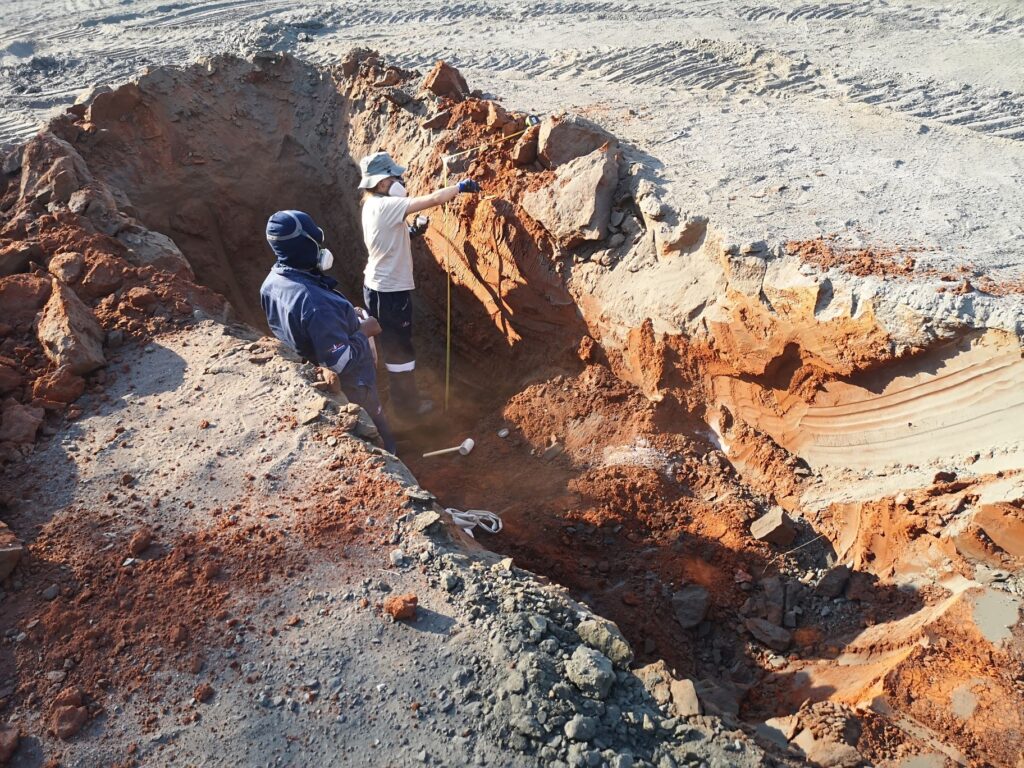
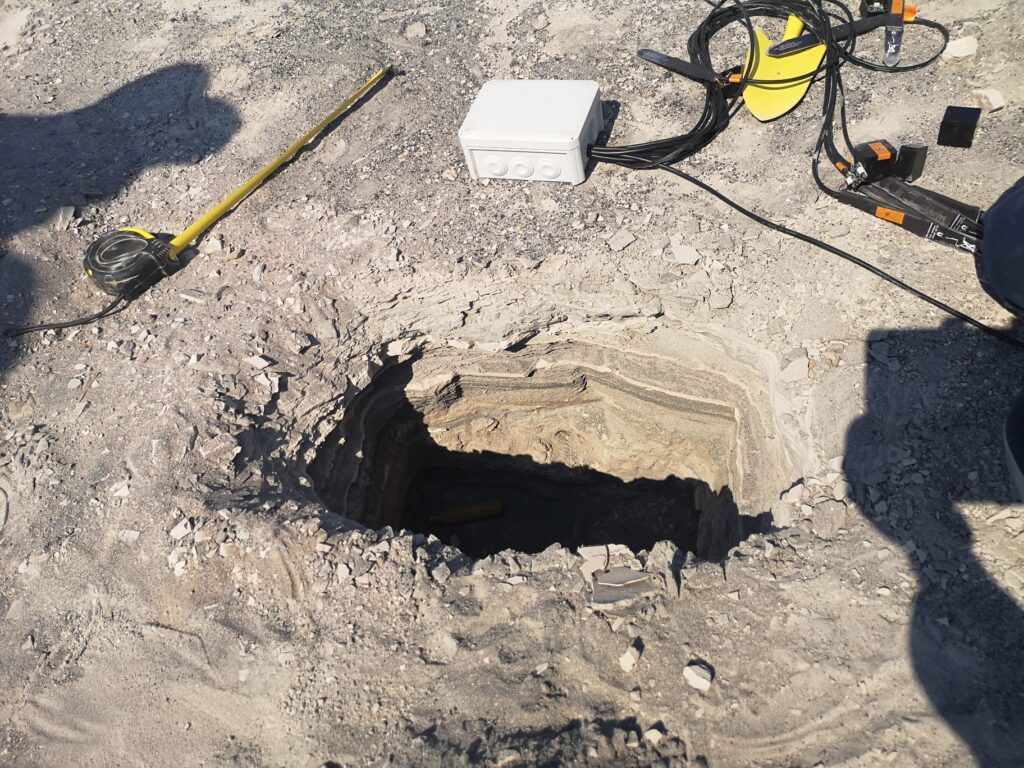
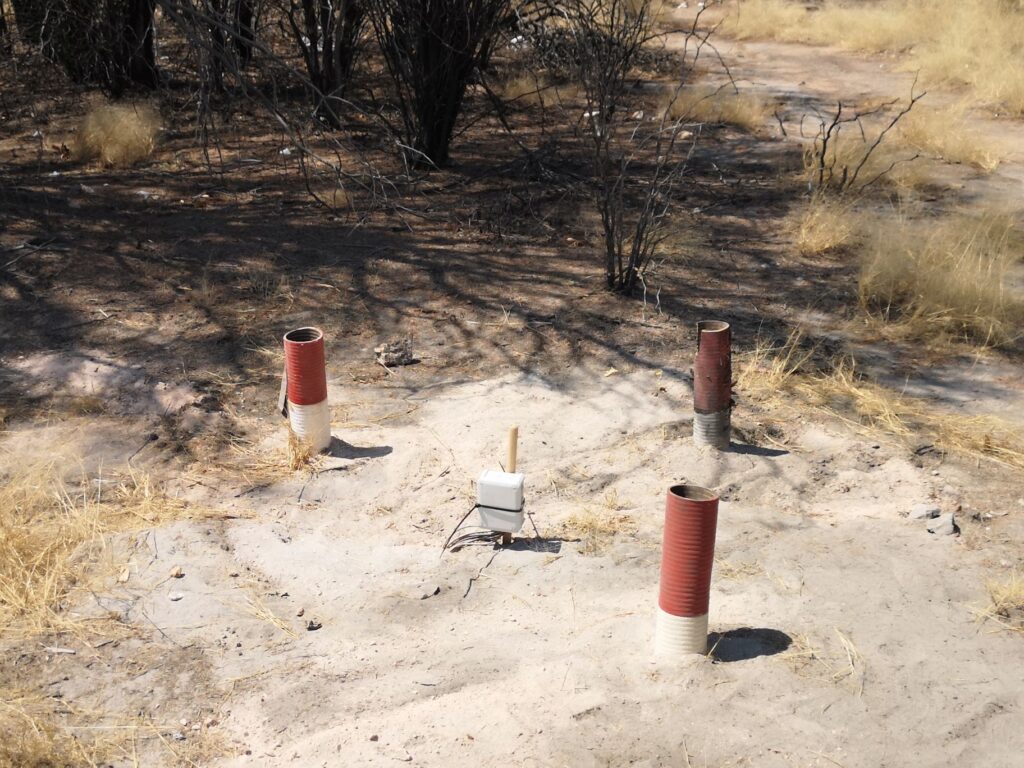
The third field campaign was carried out by Chrisoph Külls and colleagues from TH Lübeck in September 2025 to the Stampried Aquifer Region to collect data for a hydrological and hydrogeological baseline study. In October 2025, the WaMiSAR team conducted the fourth field campaign in Namibia to strengthen environmental monitoring and sample collection (Figure 1). In Tsumeb, Stefan Norra and Karoline Kny from the University of Potsdam installed a high-resolution weather station measuring temperature, humidity, and precipitation, supported locally by Sinomine. Low-cost soil sensors were added, and deeper tailings samples were collected (Figure 2). The team then sampled soils, plants, and acidic drainage water at the Matchless copper mine near Windhoek. During the final week in Rosh Pinah, together with Florian Blum from Hydroisotop and Paulina Nangombe of RPZC, additional soil sensors were installed, and multi-depth soil and water samples were collected. The fifth field campaign is carried out in February/March 2026 by Karoline Kny and Rosa Sengl from Potsdam University implementing further sensors and taking additional samples at Tsumeb, Matchless and Rosh Pinah. In addition, model-based hydrological research is also progressing. THL is advancing on python-based toolboxes, further tested for runoff and groundwater recharge assessment under arid Namibian conditions, supporting broader environmental risk evaluation and site management strategies. Likewise, project partner Aquantec GmbH continues to contribute to meteorological and hydrological data analysis, including work related to irrigation and environmental simulation studies at mining sites.
Furthermore, PhD preparation activities are progressing well. Kamuiua Kamundu from Sinomine has been officially registered as a PhD student at the Karlsruhe Institute of Technology (KIT). Her doctoral research will focus on spontaneous plant growth remediation at the mine tailing areas. Further updates on the next PhD candidate, Vazembua Tjizoo, are expected in the coming period, focusing on combined research between field observations, laboratory experiments, and groundwater modelling, developed with support from several project partners. Furthermore, Karoline Kny from Potsdam University started her PhD on “Integrated Assessment of Vadose Zone – Physical and Hydraulic Properties in Semiarid Mining Landscapes as a Prerequisite for Greening Measures” and Philipp Rinkel from Aquantec was accepted as PhD student at Potsdam University for the subject “Modeling the Water Balance of Mine Residue Deposits: A Multi-Scale Approach Using Coupled Simulations of Vadose Zone Processes Under Climate Variability”.
…and continued support to sustainable water and soil management in mining-affected regions of southern Africa. Stakeholder engagement remains an important component of the project. Discussions are ongoing with industry partners including Sibanye Stillwater regarding potential workshop activities and sampling campaigns. In parallel, water treatment applications have been implemented at selected demonstration sites.
Publications/Press releases:
The participation of several students and project partners (Kamuiua Kamundu – Sinomine, Vazembua Tjizoo – Sinomine, Florian Blum – Hydroisotop, Karoline Kny – UP and Rennie Munyayi – NUST) in a summer school and symposium organized by WASA in Lusaka, where project results were shared and regional scientific exchange was promoted.
Completed thesis: 2 BSc at Karlsruhe Institute of Technology, focusing on irrigation simulation for potential onsite regreening strategies and environmental risk assessment of current element concentrations, as well as 1 MSc at University of Potsdam on the potential of mine residual deposits as plant habitats at Tsumeb and Rosh Pinah tailings.
Karoline Kny will represent WaMiSAR on the EGU in May 2026 with a contribution on “Integrated Assessment of Vadose Zone Physical and Hydraulic Properties in Semiarid and Arid Mining Landscapes in Namibia” and Stefan Norra will represent WaMiSAR on the World Congress of Soil Science in Nanjing in June 2026 with the topic “The dependency of spontaneous vegetation growth on soil and tailing material on mine residue deposits at different climates in Namibia”.
A project flyer summarising WaMiSAR activities has been finalised and is available for distribution via the WaMiSar webpage.
Upcoming Events in 2026:
Addressing Lead Contamination in a Namibian Mining Town
The WaMiSAR team continues to advance its research on sustainable water and soil management in mining-impacted regions of southern Africa. As part of common efforts, project partners have been investigating innovative remediation approaches for lead-contaminated soils in the desert town of Rosh Pinah, Namibia.
In 2025, elevated lead and zinc concentrations were confirmed in soil samples from the town, prompting action by the local mining partner. To support evidence-based solutions, the laboratory Sensatec GmbH in Kiel was commissioned to evaluate techniques to stabilize and immobilize lead in contaminated soils. Early results indicate that phosphate amendments effectively reduce the mobility of weakly bound lead, offering a promising method to decrease environmental and human exposure. This approach is being compared to earlier field trials using surface precipitation methods, which did not yield the desired results.
The research team’s work is closely coordinated with the Karlsruhe Institute of Technology – Institute of Applied Geosciences (KIT), with a focus on understanding how treatment can also lower lead’s bioavailability, including in scenarios where soil ingestion might occur. Preliminary scientific evidence suggests a strong potential for safer long-term outcomes through this method.
Looking ahead, if the effectiveness of the phosphate-based immobilization can be demonstrated, the mining partner has signaled interest in applying the technique across multiple hectares of contaminated areas in and around Rosh Pinah. Such an approach could reduce the need for extensive soil removal in community spaces like schools and private gardens, providing a more practical and sustainable remediation option.
Capacity building activities: summer schools and continuation of the MiWaNet webinar series
The consortium is exploring the organisation of future training schools, potentially in connection with the in-person project meeting planned at the Namibia University of Science and Technology, end of 2026.
Our webinar series will continue throughout the coming months. On 26 February, we will host a session together with Philipp Rinkel (Aquantec) on “Flood Forecasting and Heavy Rain Protection through Hydraulic Modeling”, followed by a webinar with Prof. Dr. Christoph Külls (THL) on 26 March about “Why hydrochemistry can be a game changer in hydrogeological studies – and how”. The webinars provide a platform for sharing project results and promoting dialogue with partners and stakeholders.
Kind regards,
The WaMiSAR Team